Exercises
Double Time - For Half Of The Limbs Only
The following exercise is easy to sight-read. But that way it does not really meet its purpose. The notation is just to explain it. To get most out of the exercise, try to play it by heart.
- The right hand (ride cymbal) plays an ostinato. Start with what is written out here (just eighths), but you may change later to other rhythms like a swing pattern, latin grooves, or whatever.
- The left foot (hi-hat) guides with a simple but steady rhythm. Here it is written on the 2 and 4, but you may also try out quarters (1, 2, 3, 4) or all the off-beats (1&, 2&, 3&, 4&).
- The right foot (bass drum) and the left hand (snare) just play boom-chuck, i.e. bass drum on 1 and 3, snare on 2 and 4; sounds familiar, right? So far nothing complicated. But here comes the challenge: After having repeated the first bar a few times, you play double time, i.e. quarters where you had half notes before. And after a few repeats in this mode, you enter the next level of double time, i.e. bass drum and snare alternate in eighths now.
Take your time to learn the version as written above. When you feel safe with those, apply one of the variants proposed above. It is an interesting exercise, no matter whether you play it on the drum set or just on furniture and floor.
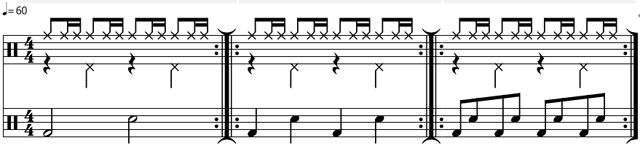
On purpose this exercise was written into two systems: The purpose is not to seek vertical connections (which limbs to play together etc.), but to play two (or in fact four) different voices simultaneously.
And don't forget: Play slowly and play by heart (don't read)!
Slow is fine, but very slow is the real challenge
Quarter notes at 50 to 60 beats per minute do not sound like a real challenge. But wait: Switch a metronome to a dark click sound (like the sound of a classic metronome) and set it to 52 beats per minute. Now play quarter notes on a practice pad to the metronome sound and listen very carfully. Record what you are doing here. A simple smartphone audio recording is sufficient. Play this for a minute or two.
Then listen backListen back to the recording). And? What do you hear? Do the beats on the practice pad cover the metronome click exactly? Or does it more sound like you (and the metronome) were playing flams together? I still remember how it shocked me when doing this for the first time. But whatever bad it sounds: You can fix it by practicing this on a regular basis for a few minutes.
When you feel that your beats cover the metronome click good enough, you are ready for the next, really challenging exercise, which should start at a very slow tempo. Let's say you start with 40 quarters per minute and successively move up to 80.
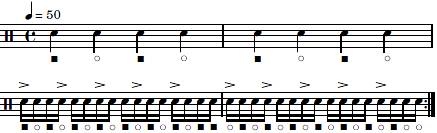
My main observation was that we tend to accelerate during the sixteenth and/or to play the quarters after the sixteenth too late. But again: Practicing helps. Note that what you learn here (timing and precision) makes you a better drummer. Forget chops and speed: This is what counts!